
中文/EN
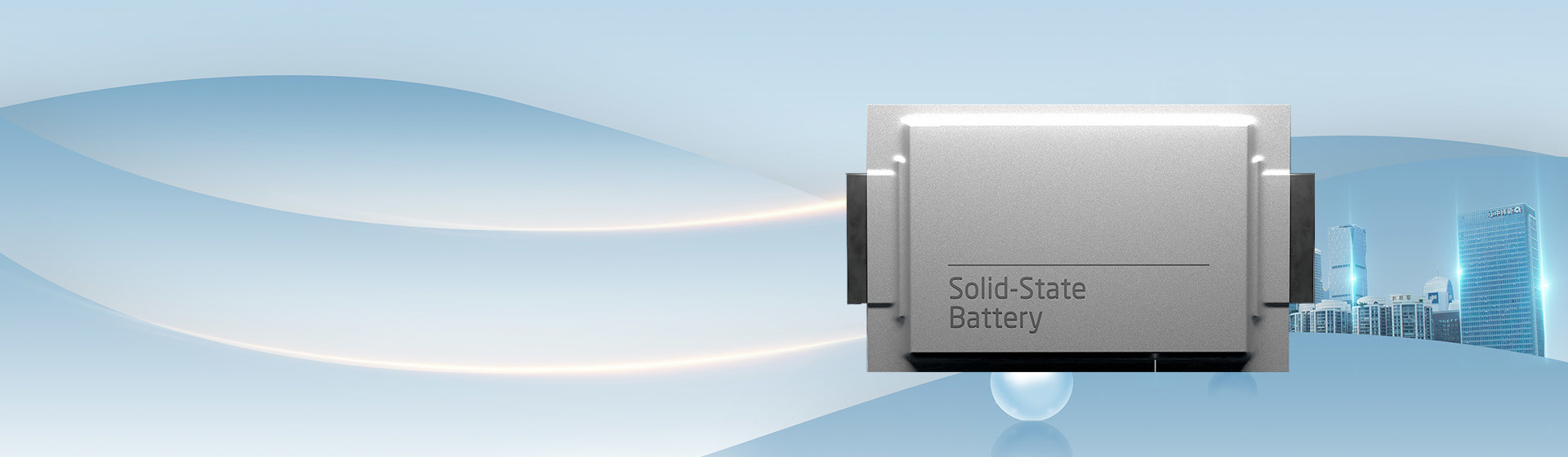
固态电池
公司持续聚焦高安全动力及储能用聚合物、氧化物、硫化物、复合电解质等系列固态安全电池产品的开发 ,为全球客户提供安全的电源解决方案
Solid-state battery

High safety, high cost-effectiveness, and long cycle life
The company remains focused on developing a range of solid-state, safe battery products—featuring polymer, oxide, sulfide, and composite electrolytes—for high‑safety power applications and energy storage, providing global customers with secure power solutions and accelerating the world’s transition to safe, sustainable energy. We offer end-to-end lifecycle solutions for both power batteries and energy storage systems, tailored to diverse user needs. Furthermore, we hold complete proprietary intellectual property rights across technology, processes, and manufacturing.
The company’s product lineup boasts features such as “high safety, high cost‑effectiveness, and long cycle life,” “low‑temperature performance with low internal resistance,” and “wide operating temperature range, wide voltage tolerance, and fast charging.” All battery cells have undergone rigorous overcharge/overdischarge and puncture tests, demonstrating no ignition, combustion, or explosion—fully addressing cell‑level safety concerns and industry‑wide pain points. Moreover, they outperform conventional lithium batteries in multiple key areas, including energy density, cycle life, low‑temperature discharge capability, fast‑charging speed, operational temperature range, and safety and environmental sustainability.
Basic Principles of Industry
The solid-state safety battery, developed over more than a decade of intensive research and testing by the aerospace technology team at Ark Investment’s Zhongke Juling, is now being applied to both power‑train and energy‑storage products, making it one of the highest‑quality offerings in the battery industry today.
Its performance characteristics are as follows:
Technical Core
A novel polymeric material, obtained through physicochemical processing under the combined action of temperature and pressure, serves as a precursor for both the positive and negative electrodes of batteries. A state-of-the-art honeycomb ceramic electrolyte membrane is synthesized and embedded with metal‑conductive ions, enabling the fabrication—via an innovative process—of solid‑state, safe batteries based on multi‑component polymer systems.
Eight Major Breakthroughs in Solid-State Safety Batteries
Low internal resistance, low temperature rise
Air-conditioning cooling → air-cooling; reduces costs;
Wide operating temperature range
Unrestricted by geography or climate, reducing the cost of temperature-control systems.
Solid-state electrolyte
No risk of combustion; aerosol-based fire suppression can be used, reducing costs.
Flexibility
Diverse forms, adaptable to different spaces.
Lightweight
Aluminum-plastic film packaging with high energy density
Small size
High volumetric density, space-saving
Good cycling performance
Cycle life of 5,000 to 10,000 cycles
High security
Solid-state electrolytes are non-combustible.

New Technological Breakthrough
The company’s product lineup features high safety, excellent cost-effectiveness, and long cycle life; low-temperature operation with low internal resistance; as well as wide temperature and voltage ranges and fast charging capabilities.

01
Breakthrough in Safety Performance
The battery cell has passed penetration, drop, and compression tests conducted by the testing department; it also successfully withstood a gunshot‑impact test without exploding or catching fire, and remains fully functional.

02
Breakthrough in Application Scenarios
Employing aerospace-grade waterproof technology, the battery functions normally even at shallow depths; it meets military‑grade standards, enabling operation in extreme environments, with an operating temperature range of –43°C to 80°C.
03
Breakthrough in manufacturing process
To simplify the assembly process, individual cells can achieve capacities of 500–1000 Ah, thereby addressing the issue of poor parameter consistency in batteries assembled using conventional PACK configurations.
With innovation as the vessel and green as the sail
Embarking on a journey toward sustainable development with the Ark, reaching for the stars and the vast ocean.
.
Copyright © 2024 Ark Group All Rights Reserved.